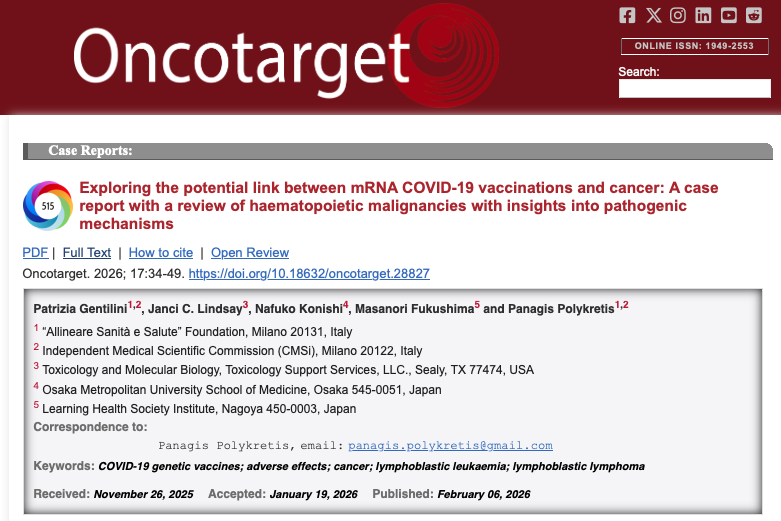
A new paper in the scientific journal Oncotarget has reignited debate over the safety of mRNA COVID-19 vaccines. Toxicologist and molecular biologist Janci Lindsay and her co-authors describe a possible link between mRNA vaccination and the occurrence of certain forms of blood cancer. In parallel, the authors published a second article in which they claim that their research was obstructed for years through systematic censorship within the scientific publishing sector.
Source: uncutnews.ch, February 13, 2026
The study, titled Exploring the potential link between mRNA COVID-19 vaccinations and cancer, is structured as a case report combined with a literature review. It centers on the case of a young, previously healthy woman who developed acute lymphoblastic leukemia (ALL) and lymphoblastic lymphoma (LBL) after receiving her second dose of the Pfizer/BioNTech vaccine.
The authors point to existing scientific literature indicating that the modified mRNA material, packaged in so-called lipid nanoparticles, can distribute more widely in the body than originally assumed. According to these findings, bone marrow and other blood-forming organs could also be reached.
In their analysis, Lindsay and colleagues discuss several biological mechanisms that could potentially be involved in oncological processes. These include disruptions of immune regulation, T‑cell suppression, alterations in interferon responses, inhibition of apoptosis (programmed cell death), and increased production of TGF‑β, a growth factor associated with aggressive tumor development. In addition, the authors highlight reports of plasmid DNA contamination in mRNA vaccines, including sequences of the SV40 promoter used in the manufacturing process.
In the authors’ view, these findings deserve particular attention because mRNA vaccines do not function solely as classic vaccines but also exhibit characteristics of gene therapy products. In this context, they refer to existing guidelines from agencies such as the FDA and EMA, which discuss theoretical risks such as DNA integration and genotoxicity.
In their conclusions, Lindsay and her co-authors call for more extensive research to better understand potential long-term consequences of mRNA technology. This is especially necessary given the rapid expansion of mRNA platforms into additional vaccines and medical applications.
At least as noteworthy as the study’s content is its path to publication. In a second paper titled Censorship in science, the authors describe a publication history they themselves call extraordinary and troubling. Between 2024 and 2025, the manuscript was submitted to sixteen journals and rejected sixteen times—often without substantive review. Only three journals actually sent the manuscript out for peer review.
In the journal Current Proteomics, the study was even accepted twice following peer review, only to be withdrawn before publication on both occasions. According to the authors, this did not happen due to new scientific objections, but because the conclusions were classified as “controversial.” Lindsay subsequently resigned from the journal’s editorial board.
The central criticism the authors say they repeatedly heard from various editorial offices was that mRNA vaccines could not cause cancer because they do not enter the cell nucleus and do not integrate into human genetic material. In the authors’ opinion, this argument is too narrow, since carcinogenesis is a complex process in which chronic inflammation, among other factors, may also play a role.
Lindsay and her colleagues stress that open scientific debate is indispensable. Systematically excluding divergent hypotheses, they argue, leads to a distorted impression of scientific consensus and prevents potential risks from being recognized at an early stage.
Publication in Oncotarget therefore does not mark the end, but rather the beginning of a broader debate—not only about possible long-term effects of mRNA technology, but also about how science deals with uncertainty, controversy, and dissenting voices in times of social and political pressure.