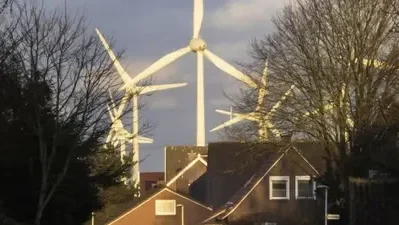
For a long time, the wind power lobby and green ideologues have downplayed the health effects of wind farms. Now, a French court has confirmed what many people living near such installations have repeatedly complained about: infrasound affects human health.
Source: report24.news; Heinz Steiner, 04 February 2026
Again and again, residents living close to wind parks report health problems that they attribute to the wind turbines. Headaches, insomnia, and diffuse anxiety—caused by the infrasound generated by the rotor blades—are among the most common symptoms. One such case was heard before a French court. In the northern French département of Somme, a former teacher filed a lawsuit against a wind farm consisting of twelve turbines located more than 500 meters from her home. Since operations began in 2009, she suffered from severe headaches, sleep disturbances, stress, and anxiety that she had never experienced before. A neurological assessment found that her symptoms regularly disappeared whenever she left the area or when the turbines were switched off. For the judges in Strasbourg, the connection was deemed “direct and certain.”
The court focused on medical reports and technical measurements. The plaintiff presented studies on low-frequency sound and infrasound—those frequencies below 20 hertz that cannot be heard but are physically perceptible. However, these frequencies play virtually no role in authorization procedures, simply because they are not audible.
The judges explicitly noted that visual stress factors also played a role. The constantly flashing lights on the turbine masts—white during the day and red at night—created a persistent state of stress that at times made life inside the plaintiff’s own home unbearable.
The plaintiff’s attorney described the verdict as a historic moment. For the first time, a court has explicitly recognized that wind turbines can harm not only landscapes but also people. Legally, this falls under the category of an “abnormal neighborhood disturbance.” This means that the plaintiff (and any similarly affected individual citing this ruling) can now seek compensation, demand operational restrictions, or even request the shutdown of the turbines.
For investors and operators of such wind parks, however, this ruling represents a serious setback. Banks, insurers, and investment funds react sensitively to legal uncertainty. When wind farms can no longer be regarded as practically liability-free infrastructure but instead as potential sources of damage claims, financing costs rise—or projects may be canceled entirely. The ruling therefore significantly increases what is known as project risk.